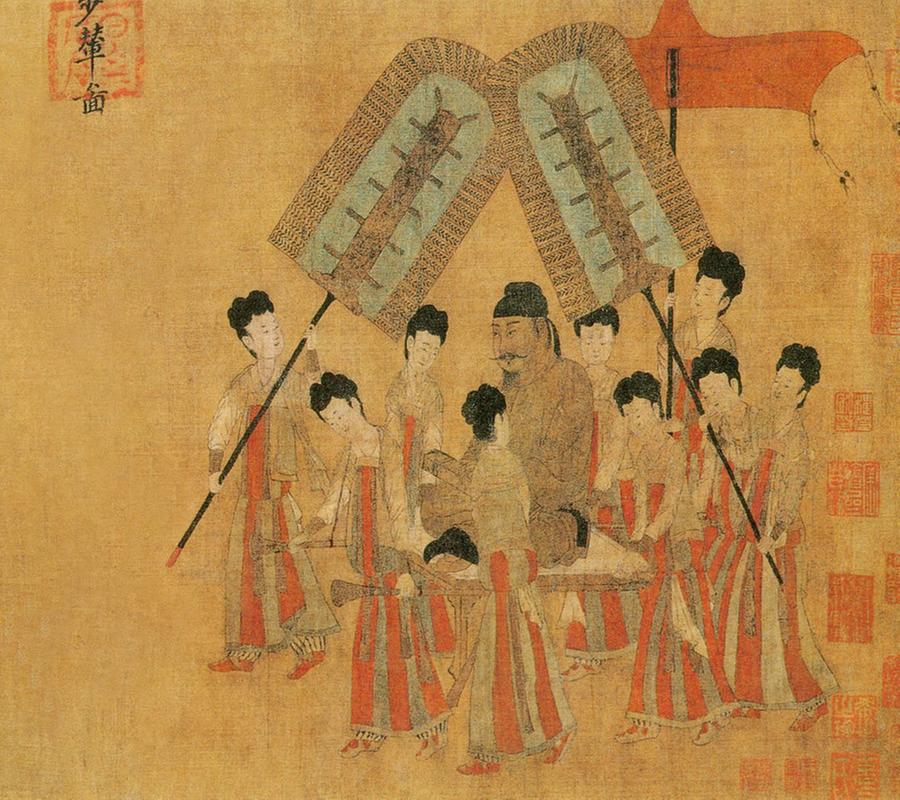
Emperor Taizong of Tang Dynasty
Introduction
Emperor Taizong of Tang, also known as Li Shimin, was the second emperor of the Tang Dynasty (618-907), reigning from 627 to 649. His reign is often regarded as one of the most brilliant in Chinese history, characterized by significant military conquests, cultural prosperity, and the implementation of reforms that strengthened the Tang Empire. Under his rule, the empire not only expanded territorially but also experienced unprecedented cultural and economic growth. The period of his reign, known as the Zhenguan era, is seen as a golden age that set the foundation for the prosperity of the entire dynasty.
Early Life
Li Shimin was born in 598 to Li Yuan, the Duke of Tang, who later became Emperor Gaozu of Tang. From a young age, Li Shimin displayed extraordinary talent and intelligence. He was well-educated in Confucian classics and martial arts, which equipped him with both scholarly and military prowess. During his father’s rebellion against the Sui Dynasty (581-618), Li Shimin proved himself as a capable military leader in several campaigns, gaining fame for his strategic acumen and valor on the battlefield. His contributions were crucial in the establishment of the Tang Dynasty, and he played a significant role in his father's rise to power as Emperor Gaozu.
Ascension to the Throne
Li Shimin's path to the throne was marked by internal family conflicts. Although he was not the eldest son, his competence and achievements made him a natural contender for succession. However, tensions arose with his elder brother Li Jiancheng, the Crown Prince, and his younger brother Li Yuanji. These tensions culminated in the Xuanwu Gate Incident in 626, where Li Shimin orchestrated a coup that resulted in the death of his brothers. Following this power struggle, Emperor Gaozu abdicated in favor of Li Shimin, who ascended the throne as Emperor Taizong.
Reign and Achievements
Emperor Taizong's reign is renowned for its military, political, cultural, and economic accomplishments.
Political Reforms
Emperor Taizong implemented a series of political reforms that stabilized the empire and enhanced administrative efficiency. He established the imperial examination system, which aimed to recruit talented individuals based on merit rather than aristocratic background. This reform not only broadened the base of the bureaucracy but also fostered a more equitable and capable government. He also emphasized the importance of good governance, often consulting with ministers and advisors to seek their opinions on various state matters. His receptiveness to advice and criticism was instrumental in creating a stable and prosperous government.
Military Campaigns
Emperor Taizong was an exceptional military strategist and expanded the Tang Empire through a series of successful military campaigns. His conquests extended the empire's borders to Central Asia, the Korean Peninsula, and the regions south of the Yangtze River. His victory over the Eastern Turks was particularly significant, as it secured the northern borders and brought peace to the region. Furthermore, his diplomatic initiatives with neighboring states, such as the marriage alliance with the Tibetan Empire through Princess Wencheng, reflected his adeptness at using both military and diplomatic means to strengthen the empire's position.
Cultural and Economic Developments
The Zhenguan era under Emperor Taizong witnessed remarkable cultural and economic developments. The emperor was a patron of the arts and fostered the flourishing of literature, painting, and calligraphy. The famous Longmen Grottoes, which reflect the cultural zenith of the Tang Dynasty, include works from this period. Economically, he implemented reforms to improve agricultural productivity and trade, leading to increased prosperity and stability. The Silk Road played a crucial role during his reign, facilitating trade and cultural exchange between China and the western regions, thereby enhancing the empire's wealth and cultural diversity.
Relations with Neighboring States
Emperor Taizong maintained diplomatic relations with various neighboring states through both military prowess and strategic alliances. His marriage alliance with Tibet, the diplomatic missions to Central Asia, and his engagement with Korean states through military campaigns exemplified his multifaceted approach to foreign policy. These actions not only secured peace along the borders but also facilitated cultural exchanges that enriched the Tang Dynasty's cultural heritage. The painting "Emperor Taizong Receiving the Tibetan Envoy" illustrates the diplomatic relations fostered during his reign, symbolizing the Tang Empire's international influence and prestige.
Historical Evaluation
Historically, Emperor Taizong is revered as one of China's greatest emperors. His reign is celebrated for its political stability, cultural richness, and territorial expansion. Scholars and historians have praised his ability to govern effectively and his willingness to listen to diverse perspectives. Emperor Taizong's contributions to Chinese history are undeniable, and his reign remains a benchmark for effective leadership and governance in the annals of Chinese history.








